Long time no new entry. 🙂 Internship is keeping me very busy. In this blog entry I’ll show you how to select a drop down option by specifying its index number.
(more…)
Category: Coding
-
JavaScript: Setting the selected dropdown option by its index number
-
Inline Frame that automatically adjusts its height for the source page
Last year, I was working on our MULPROJ layout, and the type of layout I was making needed an iframe whose height is auto resized according to the source page’s content. This means that there should be no vertical scrollbar in the iframe, it simply adjusts itself vertically.
I thought that it wasn’t possible to do this but I found a JavaScript code that can do the trick, and I just want to share it with you. 😉
(more…) -
Cobol Compilers free download: MFCICS, Microsoft Cobol 2.20, Cobol IDE
I used to have several Cobol compilers available for free download in my old blog, Poochycat.com. That blog has gone, months ago, I think.
I’m putting up all those Cobol compilers in this post. 🙂
(more…) -
IE Tester – see how your web pages look in different versions of IE (Windows Internet Explorer)
(Post taken from my old blog, Poochycat.com)
Ahh, it seems that I posted this in our MULPROJ days. ^_^
Yesterday I woke up at 6AM. I wanted to go on with my sleep, but I couldn’t. I suddenly remembered that I haven’t tested in different versions of Internet Explorer the layout design of the website I had to submit for MULPROJ that day. It’s like God woke me up to remind me that I had to test the layout. xD
(more…) -

PDF Download: Head First Java (2nd Edition) – by Katy Sierra and Bert Bates
Learning Java? Great, this book will help you.
I uploaded this Java Programming PDF to share with IT Elective 1 (Object Oriented Programming with Java) classmates. 🙂
I searched for it in Google, and I’m lucky to find this free e-book of Head First Java – Second Edition. I can’t remember where I got it from though. It’s been days (EDIT: no, it’s been months now! or maybe years), and I got a poor memory. lol.
And by the way, I used A-PDF Split to split the e-book into separate chapters of the PDF for our convenience. The file I downloaded is only one PDF file which had 690 pages. It lags in slow computers. It’s also better off being separated by chapters for ease of reading, right? So, there. 😀
I hope the Java PDF download links on this blog entry (Head First Java – Download) help you guys, and if you do find them helpful, please LIKE my website on Facebook. To find it on Facebook, search for “Catzie.net” 😀
Download Link for Head First Java Ebook
New! The following Head First Java Ebook is of better quality than the scanned one. It’s not split into several PDFs of individual chapters though, because I have no time to do it yet. It’s one big PDF file for now.
FILE SIZE: 37.53MB
Head First Java (2nd Edition, Better Quality in One Big PDF) by Kathy Sierra and Bert Bates (Non-hotlinked from MediaFire) (unknown, 6,113 hits)
Download Links for Head First Java Ebook
The zip file that follows contains Head First Java scanned ebook split into several PDFs of individual chapters.
FILE SIZE: 31.6MBHead First Java (2nd Edition, Scanned) by Kathy Sierra and Bert Bates (Non-hotlinked from MediaFire) (unknown, 2,402 hits)
Head First Java (2nd Edition, Scanned) by Kathy Sierra and Bert Bates (on FileDen) (unknown, 1,601 hits)
Java Book Chapters
- Breaking the Surface: a quick dip
- A Trip to Objectville: yes, there will be objects
- Know Your Variables: primitives and references
- How Objects Behave: object state affects method behavior
- Extra-Strength Methods: flow control, operations, and more
- Using the Java Library: so you don’t have to write it all yourself
- Better Living in Objectville: planning for the future
- Serious Polymorphism: exploiting abstract classes and interfaces
- Life and Death of an Object: constructors and memory management
- Numbers Matter: math, formatting, wrappers, and statics
- Risky Behavior: exception handling
- A Very Graphic Story: intro to GUI, event handling, and inner classes
- Work on Your Swing: layout managers and components
- Saving Objects: serialization and I/O
- Make a Connection: networking sockets and multithreading
- Data Structures: collections and generics
- Release Your Code: packaging and deployment
- Distributed Computing: RMI with a dash of servlets, EJB, and Jini
Happy Java programming, y’all. 🙂 Make good use of the learning Java book you downloaded.
Java is a programming language originally developed by James Gosling at Sun Microsystems (which is now a subsidiary of Oracle Corporation) and released in 1995 as a core component of Sun Microsystems’ Java platform.
The syntax of Java is mostly derived from that of C and C++ programming languages, but with simpler object model and fewer low-level facilities.
-
PHP: Dynamic inclusion tutorial
I’m posting this because I thought that it might help some people who want to structurize their website in a way that they can easily edit pages which contain contents and pages which contain the code of the layout, as we separate layout code from contents in dynamic inclusion.
This is for PHP beginners, but I assume that you have basic knowledge about PHP variables and form submission methods if you would read this tutorial.
(more…) -
Assembly Language: a simple shop/store program
A small program I made a year ago in Turbo Assembler.
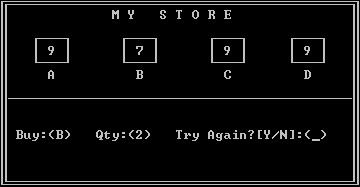
It’s a shop displaying four items, each item having 9 stocks. The user is first prompted for which item he/she wishes to buy, for the quantity of the purchase, and if he wants to buy again. The program closes once the shop runs out of stock.
-
Assembly Language: check if a one-digit input number is odd or even
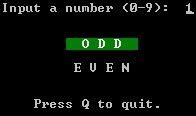
I coded this back when I was taking up Computer System Organization. It was a homework that I decided to share in my old blog.
The program accepts a one-digit number as the input, and then shows whether that number is ODD or EVEN.
The program uses the attribute byte to highlight ODD or EVEN with a color.
(more…)